ICML 2026 · May 1, 2026
Evolving Interdependent Operators with Large Language Models for Multi-Objective Combinatorial Optimization
junhaoqiu2-c@my.cityu.edu.hk · * Corresponding authors


International Conference on Machine Learning (ICML), 2026
junhaoqiu2-c@my.cityu.edu.hk · * Corresponding authors
International Conference on Machine Learning (ICML), 2026
Neighborhood search operators are critical to the performance of Multi-Objective Evolutionary Algorithms (MOEAs), yet their design remains heavily reliant on domain expertise. While recent LLM-based Automated Heuristic Design (AHD) methods have made notable progress, they focus on optimizing individual operators independently, overlooking the dynamic coupling relationships between operators that collectively determine MOEA performance.
We formulate multi-operator optimization in MOEAs as a Markov Decision Process (MDP), enabling the improvement of interdependent operators through sequential decision-making. Building on this formulation, we propose E2OC (Evolution of Operator Combination), a framework that achieves the co-evolution of design strategies and executable codes. E2OC employs Monte Carlo Tree Search to progressively explore combinations of operator design thoughts, coupled with an operator rotation mechanism to systematically identify effective operator configurations. The framework supports plug-and-play integration of mainstream AHD methods as the underlying operator designer.
Comprehensive experiments on bi- and tri-objective FJSP and TSP demonstrate that E2OC consistently outperforms expert-designed operators by 10%–22% in Hypervolume, surpasses all state-of-the-art AHD methods, and exhibits strong cross-problem generalization and sustained continuous optimization capability.
Multi-Objective Combinatorial Optimization Problems (MCOPs) — such as production scheduling, vehicle routing, and engineering design — are NP-hard. MOEAs like NSGA-II, NSGA-III, and MOEA/D are the workhorse solvers, but their effectiveness hinges critically on the selection and interplay of domain-specific search operators (crossover, mutation, local search).
The fundamental gap: In MOEAs, different operators act on overlapping or interacting decision subspaces. Modifying one operator changes the generation distribution and effectiveness of others — they may complement or conflict with each other. Designing operators independently systematically leads to suboptimal overall performance. However, both expert-driven and existing LLM-driven approaches lack mechanisms to reason about these inter-operator interactions and sequencing effects.
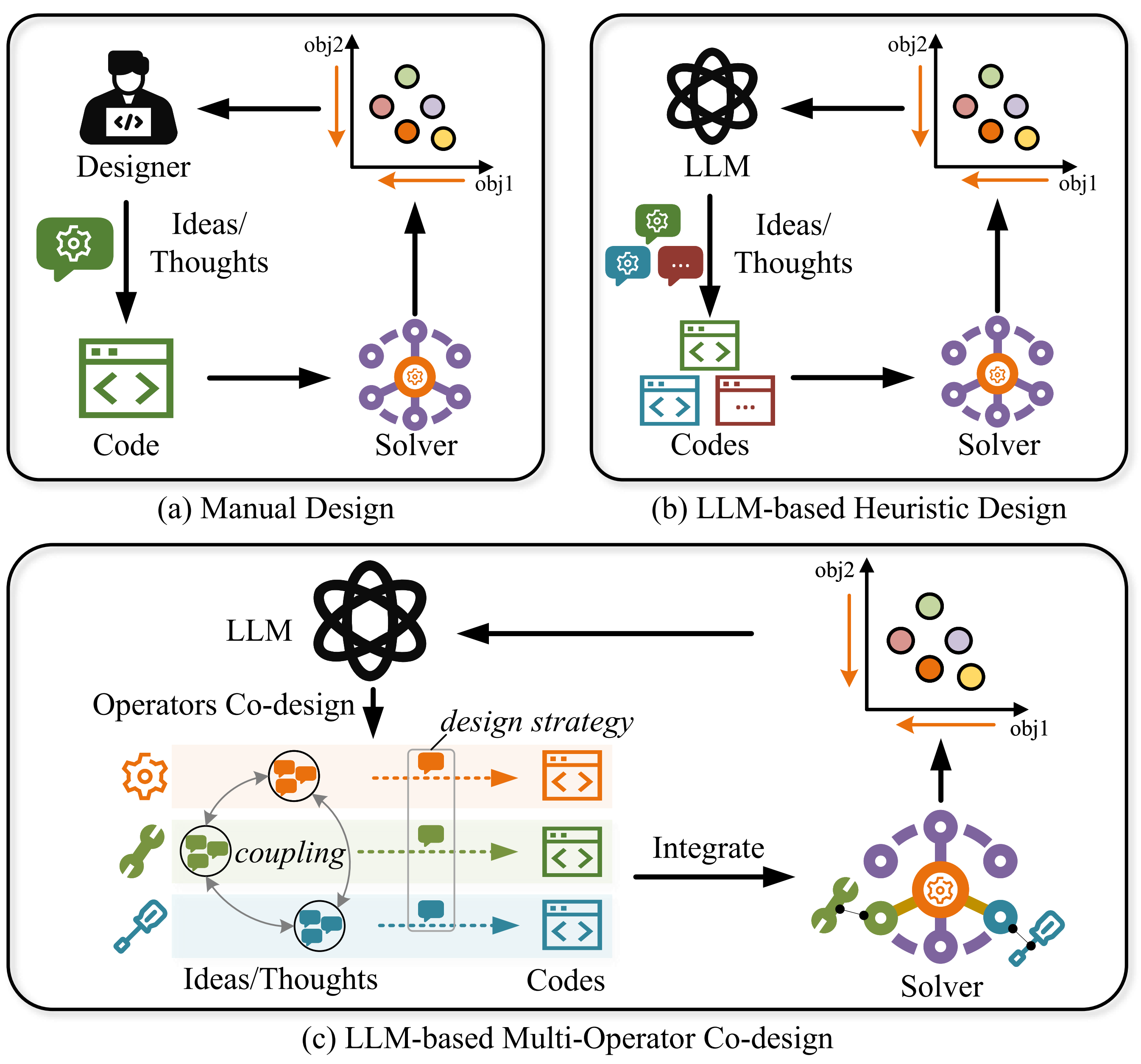
Three design paradigms: Expert hand-crafted design → Single-operator AHD (independent optimization) → E2OC co-design (coupled optimization of interdependent operators).
| Paradigm | Limitation |
|---|---|
| Expert Design | Costly, domain-specific, hard to generalize across problems |
| Genetic Programming (GP) | Requires manually defined primitive/terminal sets; limited cross-domain transfer |
| LLM Single-Operator AHD (EoH, FunSearch, MCTS-AHD, ReEvo) | Optimizes each operator in isolation; ignores coupling effects between operators |
| E2OC (Ours) | Co-evolution of interdependent operators via MDP-guided MCTS search |
A key theoretical contribution: we formalize the multi-operator co-evolution process as a Markov Decision Process (S, A, P, R):
State — the current operator combination and associated prompt information: s_t = (O₁, O₂, ..., O_K | P_t)
Action — select which operator i to evolve, and decide whether to rewrite its design prompt: a_t = (i, w_i)
Reward — improvement in scalarized multi-objective performance: R = F̄(d | O') − F̄(d | O), where F̄ is the averaged Hypervolume over N independent evaluations.
This formulation explicitly captures the dynamic, non-stationary nature of multi-operator evolution, since modifying one operator continuously reshapes the search landscape for others.
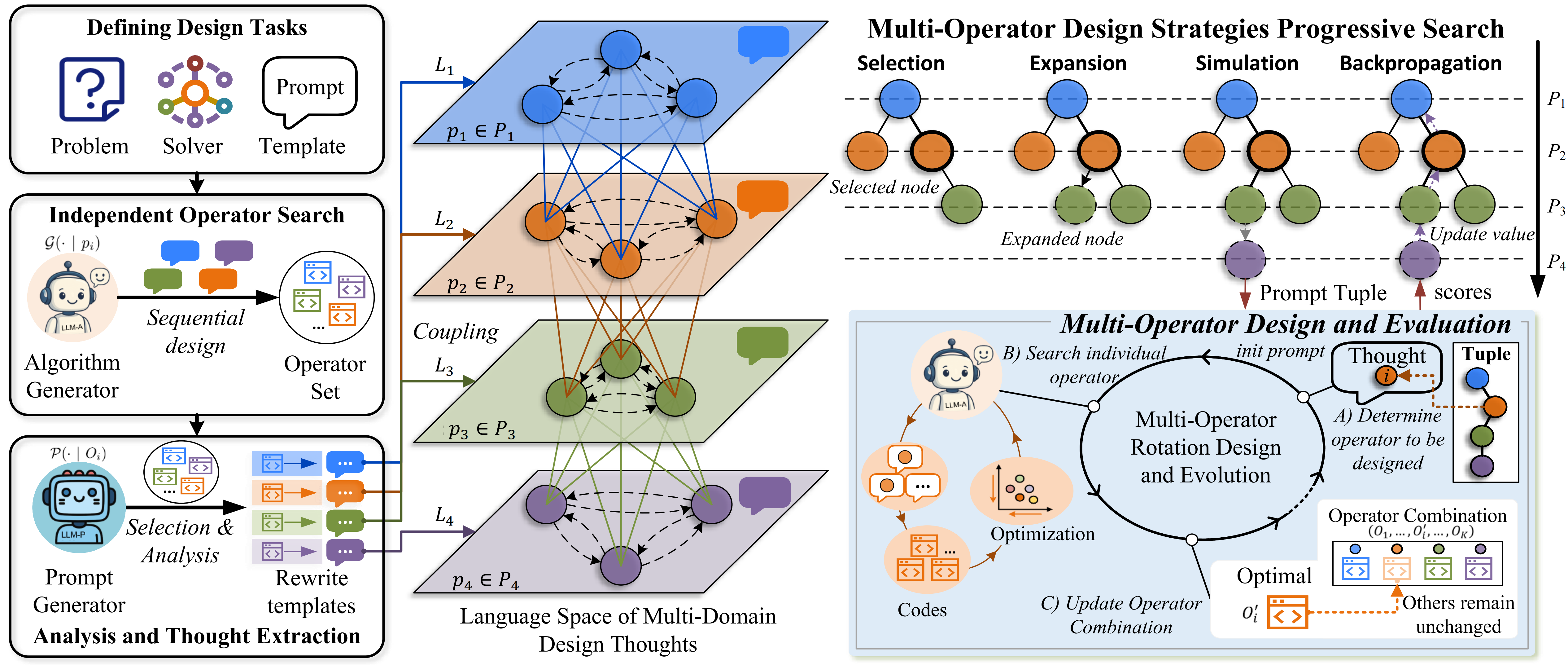
E2OC framework overview: Warm-Start → MCTS Strategy Search → Operator Rotation Evolution (the co-evolution loop of design strategies and executable code).
Establish an initial high-quality language space of multi-domain design thoughts — semantic-level improvement suggestions extracted from independently evolved elite operators. Through independent operator evolution, design thought extraction, and language space construction, E2OC builds a structured semantic space capturing both internal (within-operator) and external (cross-operator) coupling relationships.
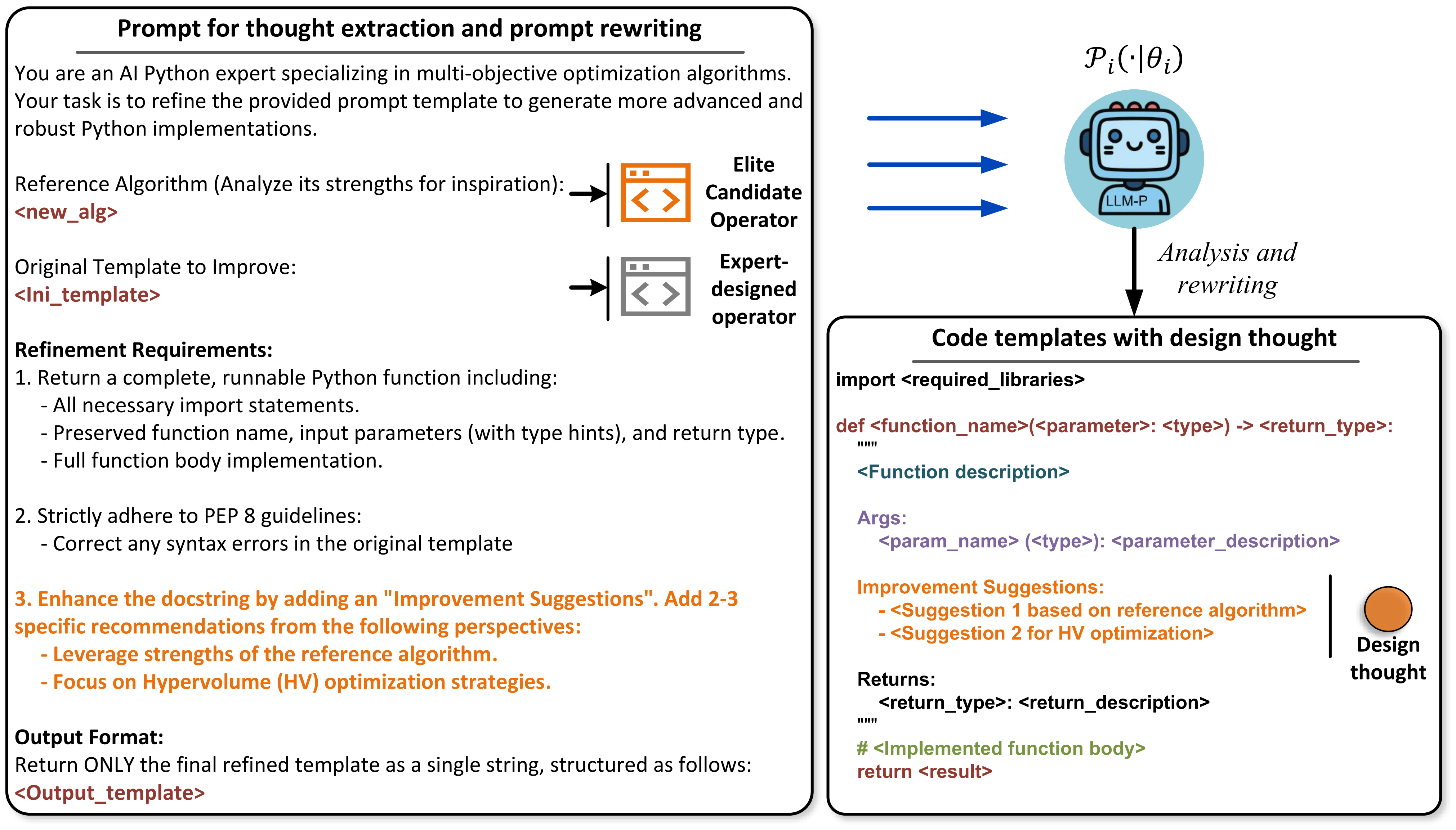
Structured prompt template for extracting design thoughts from independently evolved elite operators.
MCTS explores combinations of design thoughts across different operators to identify the most promising design strategy: a tuple (thought₁, thought₂, ..., thought_K) that guides downstream code generation. Key insight: E2OC pre-constructs a fixed set of high-quality design thoughts per operator during warm-start, bounding the branching factor from unbounded to O(AP^K), tractable for typical MOEA configurations (K = 3~4, AP = 3).
Each MCTS iteration executes Selection → Expansion → Simulation → Backpropagation, with UCB-based node selection balancing exploration and exploitation. Counter-intuitively, bounding the search space improves performance by concentrating evaluation budget on a curated high-quality subspace.
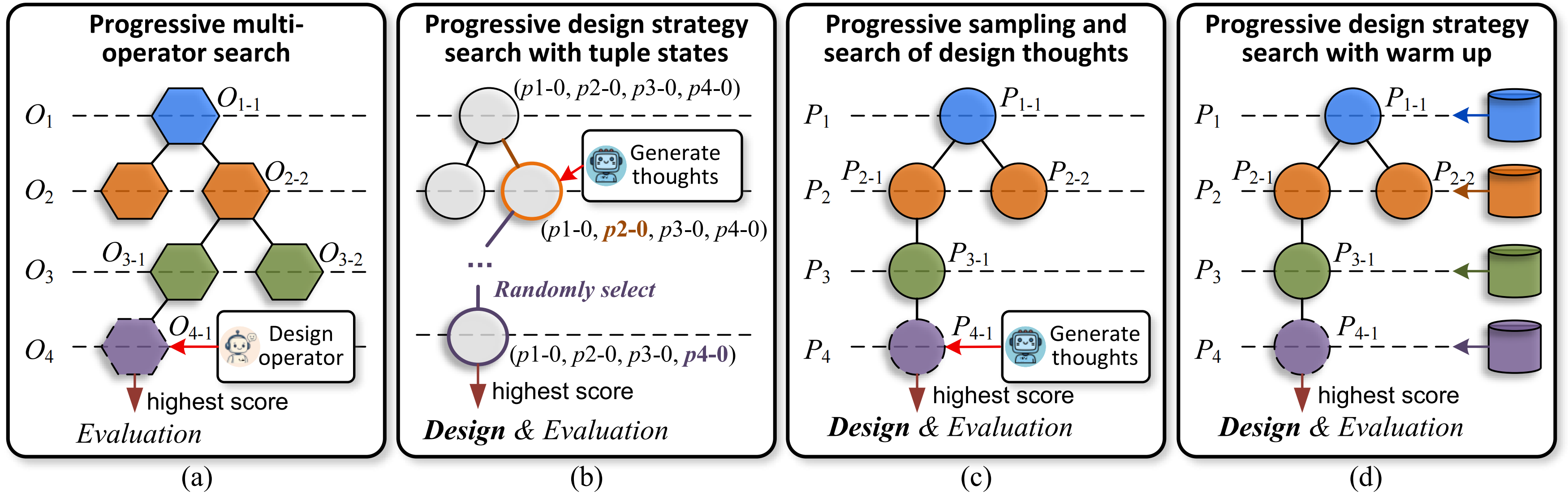
Four MCTS variant architectures: E2OC's bounded warm-start approach consistently outperforms unbounded dynamic generation variants. Counter-intuitively, bounding the search space improves performance by concentrating evaluation budget.
Given a design strategy, an operator rotation mechanism generates actual executable operators and evaluates their collective performance. Each operator is evolved and evaluated in context, within the actual multi-operator system, rather than in isolation. The algorithm generator is pluggable, supporting integration of any state-of-the-art AHD method (EoH, FunSearch, MCTS-AHD, ReEvo) as the underlying designer.
| Dimension | Configuration |
|---|---|
| Problems | Bi-FJSP (Brandimarte mk01–mk15), Tri-FJSP, Bi-TSP (20/50/100 nodes), Tri-TSP |
| MOEA Backbones | NSGA-II, NSGA-III, MOEA/D |
| Operators Designed | FJSP: 4 operators; TSP: 3 operators |
| LLM | DeepSeek-Chat (best quality-cost trade-off) |
| Metrics | Hypervolume (HV↑), IGD↓, Relative Improvement (RI%) |
| Eval Budget | ~15,500 operator evaluations (fair comparison) |
E2OC-designed operators, when plugged into standard MOEAs, consistently and significantly outperform expert-crafted operator combinations:
| Problem | MOEA | HV Gain (RI%) |
|---|---|---|
| Bi-FJSP | NSGA-II | +22.00% |
| Bi-FJSP | NSGA-III | +13.27% |
| Bi-FJSP | MOEA/D | +21.78% |
| Bi-TSP | NSGA-II | +14.00% |
| Bi-TSP | MOEA/D | +16.92% |
| Tri-FJSP | NSGA-II | +17.36% |
| Tri-FJSP | NSGA-III | +17.24% |
| Tri-TSP | NSGA-II | +6.30% |
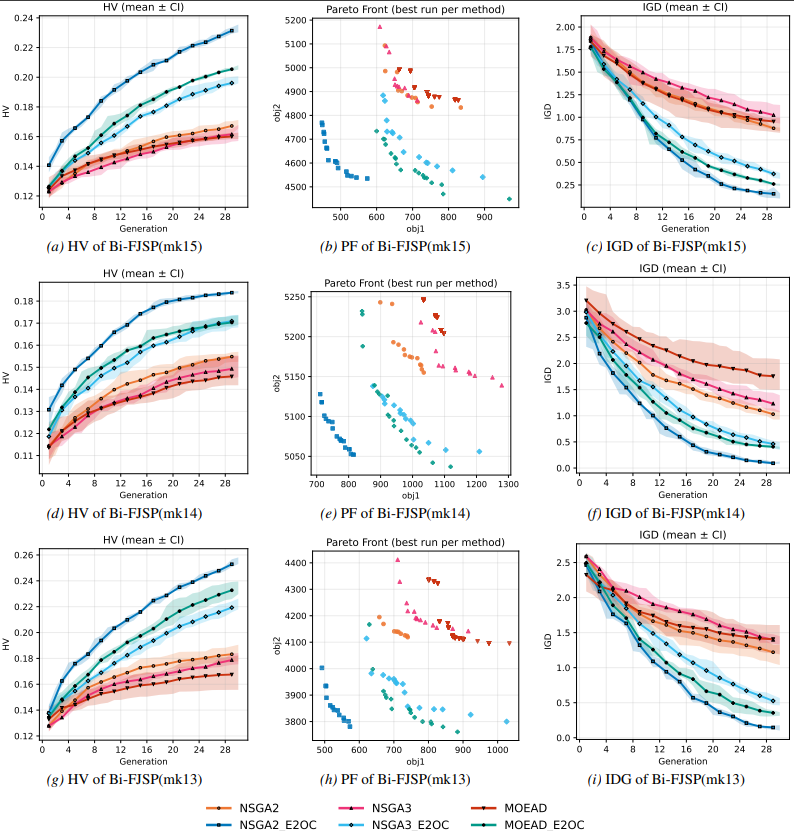
E2OC vs. expert-designed MOEAs on bi-objective FJSP and TSP benchmarks.
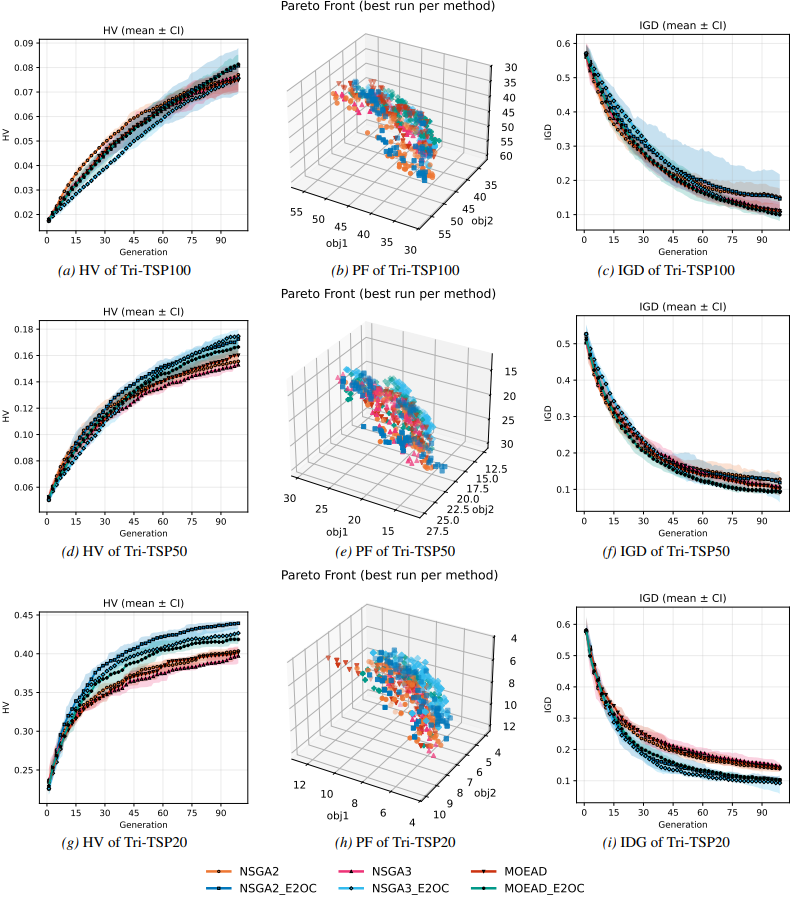
E2OC vs. expert-designed MOEAs on tri-objective FJSP and TSP benchmarks.
All methods design operators for NSGA-II on Bi-FJSP with identical evaluation budgets (~15,500 evaluations):
| Type | Method | HV (All instances) | IGD (All instances) |
|---|---|---|---|
| Single | Random | 0.2263 | 1.4193 |
| Single | FunSearch | 0.2265 | 1.4070 |
| Single | EoH | 0.2258 | 1.4352 |
| Single | ReEvo | 0.2185 | 1.6551 |
| Single | MCTS-AHD | 0.2269 | 1.3950 |
| Multi | CD (Coordinate Descent) | 0.2170 | 1.6536 |
| Multi | UCB (Bandit) | 0.2182 | 1.6300 |
| Multi | LLM-driven | 0.2148 | 1.8772 |
| Multi | Win-UCB | 0.2256 | 1.4619 |
| Multi | E2OC | 0.2435 | 1.1423 |
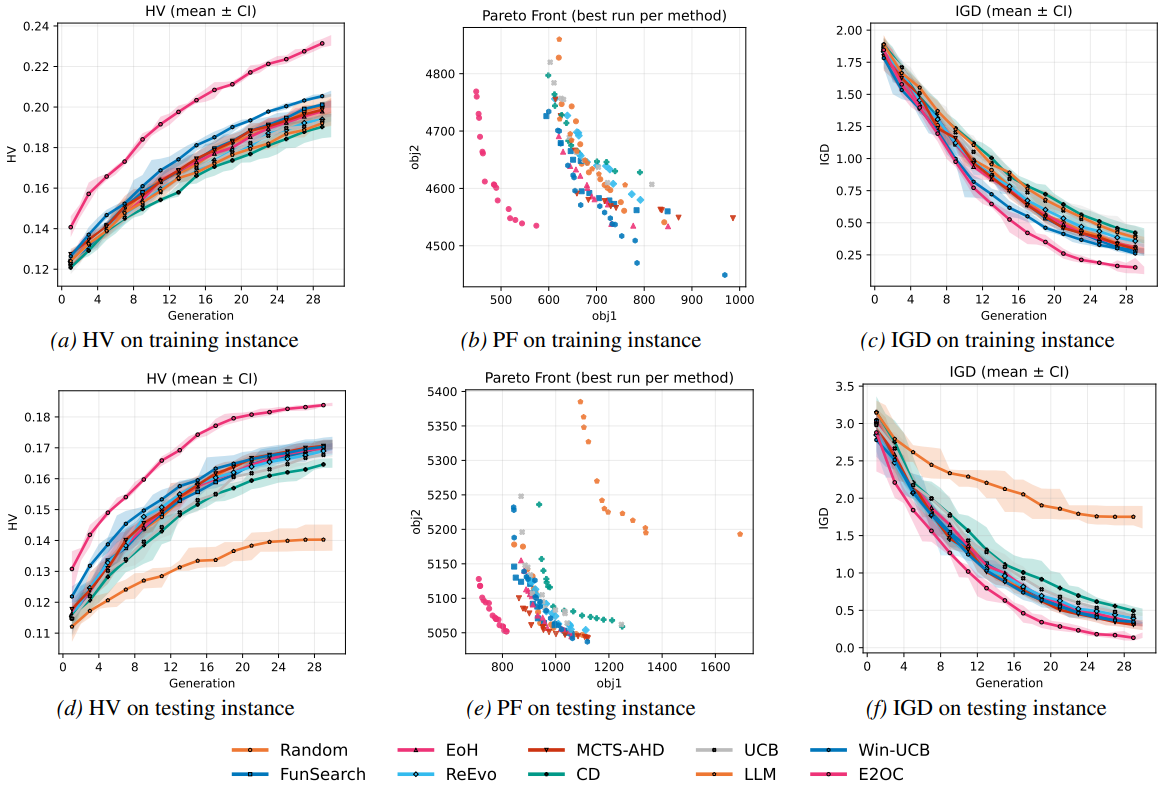
Comprehensive comparison against all state-of-the-art AHD methods under identical evaluation budget (~15,500 evaluations).
| Variant | What's Removed | HV (All) | Δ |
|---|---|---|---|
| E2OC | (full model) | 0.2435 | — |
| MCTS_OC | MCTS strategy search → fixed single strategy | 0.2085 | −14.4% |
| E2OC-SD | Operator rotation → sequential independent design | 0.2187 | −10.2% |
Each core component is indispensable. Removing progressive strategy search causes the largest degradation. E2OC amplifies the capability of any underlying AHD designer: E2OC[EoH] = 0.2435, E2OC[FunSearch] = 0.2264, E2OC[MCTS-AHD] = 0.2269.
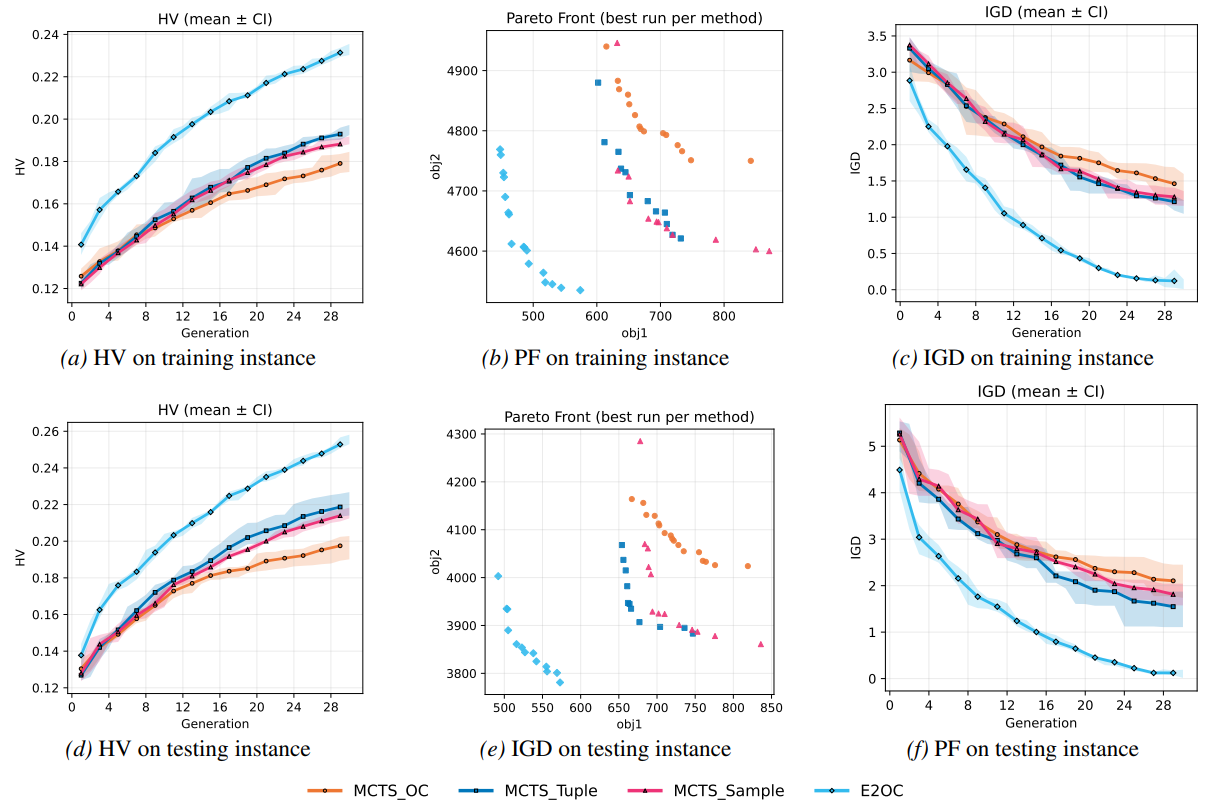
MCTS component ablation: each core component (strategy search, operator rotation) is indispensable. E2OC amplifies any underlying AHD designer.
Cross-scale: Operators trained on TSP-100 generalize to TSP-150 (+30.93% HV) and TSP-200 (+22.06% HV).
Continuous optimization: E2OC can bootstrap itself: Round 1 → HV=0.2435, Round 2 → 0.2454 (+0.8%), Round 3 → 0.2475 (+1.6%). Not trapped in local optima.
Cost: $1.14 per design task with DeepSeek-Chat, making automated operator design economically viable for real-world applications.
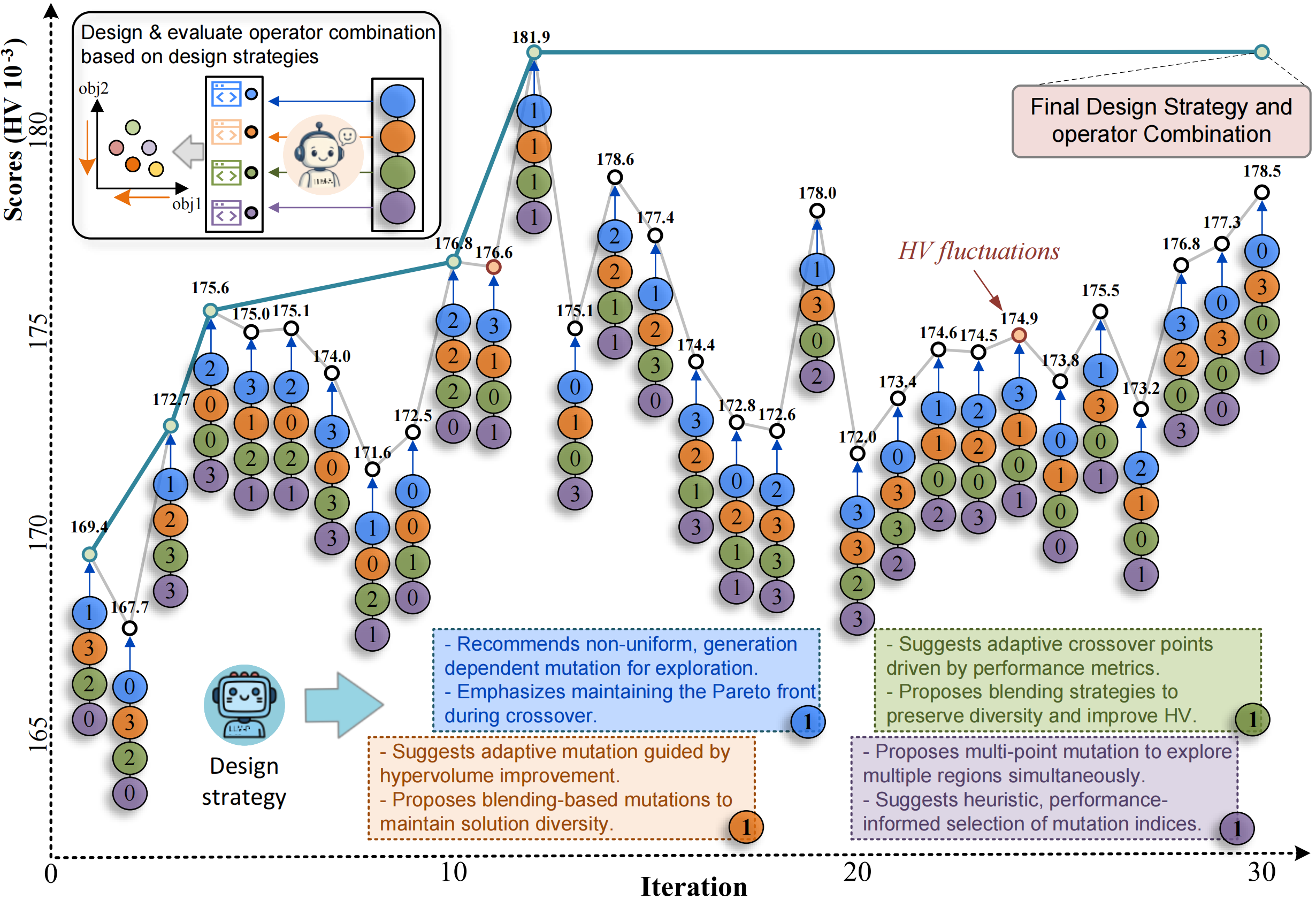
Convergence analysis: E2OC sustains continuous optimization across rounds (Round 1 → 2 → 3). Cross-scale generalization: operators trained on TSP-100 transfer to larger instances (TSP-150, TSP-200) with strong HV gains.